My trip to the Dossin Barracks in Mechelen was rather unique, because it was no ordinary visit. My Godmother has a brother-in-law who gives guides for the museum, so together with him, my godmother and my father, we went to visit the museum with him as our guide. I think this improved my overall experience of the visit and hopefully, I learned a lot from it. To show my reflection of the visit, I have used some of the example questions that I'll answer to show what I have learned and what I will remember from this trip.
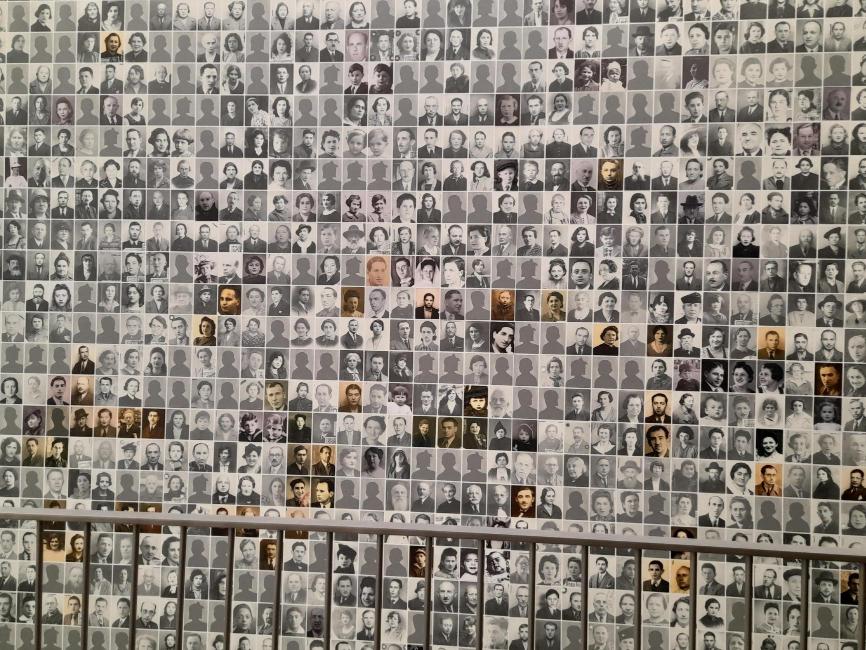
One of the most interesting things in the museum for the Dossin barracks is the 4 floor spanning wall of pictures from people who were deported from the barracks to an execution camp, some of them alive, some not. Most of the pictures that are hung there come from the passports that were taken from the people who entered the barracks. Some of them came from relatives who had a photo of the person. I find this a rather memorable and interesting sight because it allows the people who were (almost) killed to be remembered, whilst if it was not there, it would be much harder to do so. Also, it prevents people from being reduced to numbers. It shows that each person has their own experience that is different from another person, and shows that reducing people to numbers can undermine their experience. The entire wall shows that the people won't be forgotten. Actually the entire building and museum shows that the event won't be forgotten for a long time.
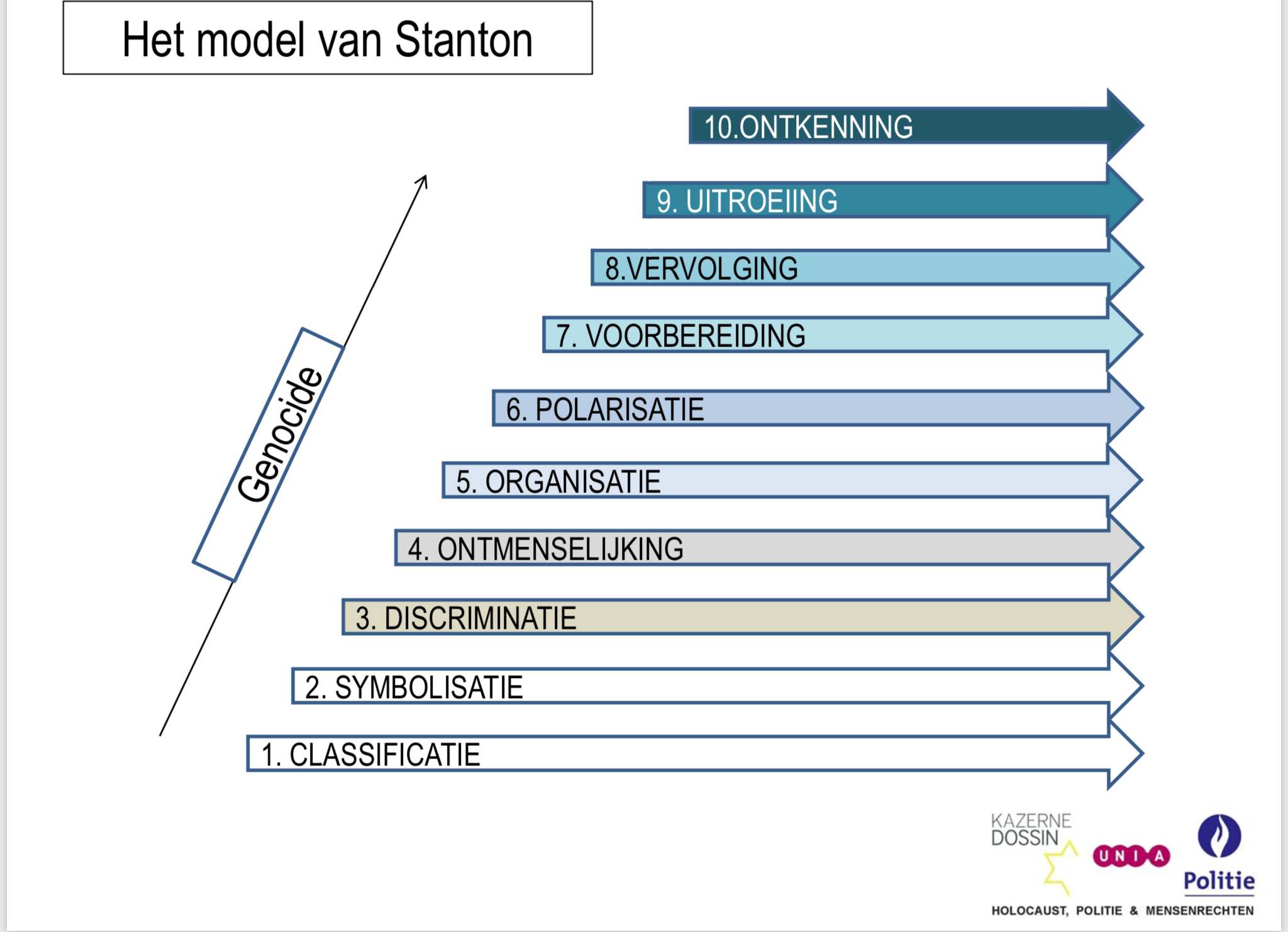
The most important thing I learned during my visit came from a graphic I got from the guide. He explained to me that genocides in history follow a similar pattern and used a model called the "Stanton model", to explain it. It starts with classification, where groups of people are divided based on characteristics like the Übermenschen and Untermenschen in the Nazi regime. This is followed by symbolisation were groups get represented by symbols like, an example of this for the Nazi regime would be the Swastika. Then discrimination and dehumanisation follow were a group of people get excluded from the rest of society, for example, when Jews had many laws applied that specifically targeted them and that they were compared to rats. The previous things still appear in our daily life, but when you go further into organisation and beyond, things start to escalate.
Organisation occurs when people actively keep administration of the disliked group. An example of this would be the Jew register that was kept of all the jews of a multiplicity to keep information of the people, including their address. During this polarisation can happen were extreme views of groups can occur, like extreme negative propaganda against a group of people. When almost at the breaking point, you arrive at preparation and persecution, were preparation are made for the genocide, like making camps and the act of actively tracking down and collecting the people. Finally, the genocide really happens when people are systematically being transported to their death like the transportations from the Dossin barracks to for example Auschwitz. The ending of a genocide usually ends with the denial of the genocide in its entirety. Although this graphic is really handy to see patterns in genocides, it is important to see that not every genocide is the same and not to generalize.
From history, we have learned that remembering the past is important. It allows us to prevent mistakes that were made previously. Although we will still make mistakes and continue to make them, but we can get better at handling them. Remembrance also makes people take action to prevent these events from repeating themselves. The entire Dossin barracks would have been removed if there were not people, who had lost people they loved, who protested against its removal. So, remembrance leads to action, but it also allows people not to be forgotten, who did not have a chance to give a final goodbye (for example, the big wall of people in the museum).